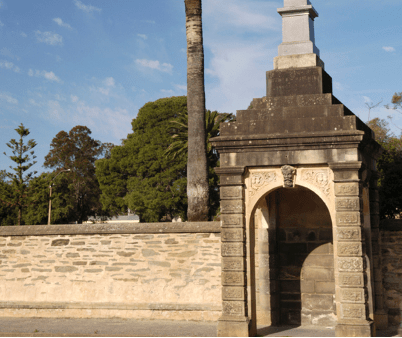
A 19th-century burial site has provided an added difficulty in the Council of Gawler’s plans to stabilize the Pioneer Park heritage Wall.
After it was deemed to be unsafe due to deterioration, The Town of Gawler Council is currently working towards stabilizing the Pioneer Park Heritage Wall on Murray Street.
With the presence of at least one 19th-century cemetery on the proposed excavation grounds, all work will require a Section 27 permit from Heritage SA and supervision from a Forensic Anthropologist.
Starting in April 2023, a shallow investigation trench will be excavated on-site to attempt to locate the whereabouts of past burials by assessing previously disturbed ground.
Mayor of Gawler, Karen Redman, explained the difficulties faced when dealing with these burial sites and how she plans to work around the issue:
“Unfortunately, Council does not have any historical documents that map where individual graves were at the cemetery, so it is not possible to identify those buried in any of the gravesites”, she said.
“The scope of the restoration works is not yet known, but Council is seeking to have the works done, while working to ensure the historical site and graves are treated with the utmost respect into the future”, Mayor Redman added.
While offsite, any remains found will be in the possession of Emeritus Wood Jones Professor Maciej Henneberg, who will be supervising the work done on the site, and his team from the University of Adelaide.
Town of Gawler CEO, Henry Inat, believes that despite the work needing to be completed, it is a great opportunity for the team from The University of Adelaide to be involved in the process:
“Whilst it is unfortunate that further excavation works are necessary, this is a rare opportunity for academic teams to increase their knowledge of the early townspeople of Gawler, as only 2 or 3 cemeteries of this era have been excavated previously across Australia”, he said.
Professor Maciej Henneberg, who will be overseeing the excavation, says there is a chance plant roots and earlier groundwork may have damaged the bones, which may bring problems:
“There can sometimes be difficulties locating the burials and then excavating them so as to obtain the maximum information about the deceased”, he said.
“These difficulties can be caused by the soil, plant roots that dissolve bones, and, possibly, earlier earthworks that can disturb burials”.
He added that the council will need to take into consideration the family members of those who will be dug up from the site:
“The council needs to deal with feelings of family members of people whose remains will be disturbed by the excavation so that families are not aggravated by the handling of skeletal remains of their ancestors”, he said.
“This includes proper re-burial at the end of the project and confidentiality of any sensitive information that may come to light during the examinations of burials and skeletal remains”.
The team from the University of Adelaide will estimate the sex and age at death of each person discovered on the site, observe any signs of pathologies, as well as taking samples for chemical analyses of stable isotopes and ancient DNA.
 Liam Barry
Leave a comment